
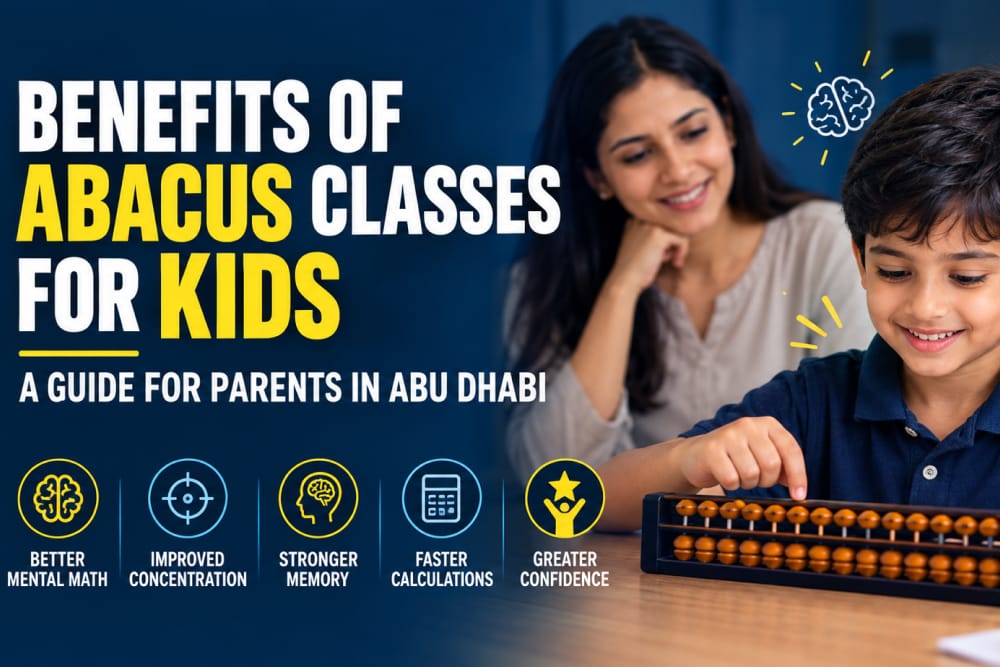
When children start learning mathematics, speed and accuracy are only part of the journey. Many parents also want their child to become more focused, confident, attentive, and comfortable with numbers.
This is where abacus classes for kids can provide a different approach to learning mathematics. Instead of relying only on written calculations, children learn to represent numbers physically and gradually develop the ability to visualize calculations mentally.
For parents exploring abacus for kids in Abu Dhabi, the biggest question is simple: What can my child actually gain from Abacus training?
From developing mental maths skills and concentration to improving number confidence and calculation accuracy, Abacus can support several useful learning skills when children receive structured instruction and practise consistently.
In this guide, we explore the key benefits of Abacus classes for kids, how Abacus learning works, what children learn during training, and how parents in Abu Dhabi can choose the right program for their child.
What Is Abacus Learning?
An Abacus is a hands-on mathematical learning tool consisting of beads arranged on rods. Children use the beads to represent numbers and perform calculations such as addition, subtraction, multiplication, and division.
With regular practice, the learning process can progress from:
Physical Abacus → Visual Abacus → Mental Calculation
Instead of always depending on the physical tool, children gradually learn to visualize the beads and perform calculations mentally.
This transition is one of the most interesting aspects of Abacus-based mental mathematics. Research and educational programs have explored how visualization, working memory, and number representation are involved in skilled Abacus calculation.
10 Major Benefits of Abacus Classes for Kids
Abacus learning is often associated with faster calculations, but its potential benefits extend beyond arithmetic.
Here are some of the most important skills children can develop through consistent Abacus practice.
Develops Faster Mental Maths Skills
One of the most visible benefits of Abacus training is improved calculation fluency.
Children learn to work with numbers systematically instead of depending entirely on fingers, written steps, or calculators.
As their skills progress, they can begin visualizing the Abacus and performing calculations mentally.
This can help children become more comfortable with:
- Addition
- Subtraction
- Multiplication
- Division
- Number combinations
- Mental arithmetic
- Multi-step calculations
The objective is not simply to make children calculate faster. It is to help them develop greater familiarity and confidence with numbers.
For families searching for Abacus Mental Math for Kids in Abu Dhabi, this is one of the primary reasons parents consider structured Abacus programs.
Improves Concentration and Focus
Children today have many sources of distraction, so learning how to concentrate on a task is an important academic skill.
Abacus exercises require children to listen carefully, follow a sequence, observe numbers, manipulate beads, and calculate accurately.
During a typical exercise, the child needs to stay engaged with the problem instead of randomly guessing the answer.
With consistent practice, this can help children develop better task-focused attention.
Importantly, Abacus should not be presented as a guaranteed treatment for attention problems. Rather, it provides repeated practice in sustained attention and following structured mathematical tasks.
Strengthens Memory Through Visualization
Abacus training involves more than memorizing arithmetic facts.
As children advance, they learn to visualize the position and movement of beads while performing calculations.
This requires them to hold numerical information in their working memory while continuing the calculation.
The combination of:
Listen → Remember → Visualize → Calculate → Respond
creates a mentally engaging learning activity.
This is one reason memory and visualization are frequently highlighted as potential benefits of Abacus learning.
Builds Calculation Accuracy
Speed without accuracy is not useful.
A strong Abacus program should therefore focus on both calculation speed and accuracy.
Children learn specific methods for representing numbers and performing calculations. Repeated practice helps them become more familiar with number combinations and calculation patterns.
Over time, children can become more comfortable checking their work and identifying mistakes.
For parents considering abacus training in Abu Dhabi, it is worth asking prospective institutes how they measure both speed and accuracy rather than focusing only on how quickly children can answer questions.
Develops Number Sense
Number sense refers to a child’s understanding of numbers and their relationships.
Abacus provides children with a visual and physical representation of numbers.
Instead of seeing only:
7 + 5 = 12
a child can physically represent the numbers and understand how the quantities change during the calculation.
This hands-on approach can make abstract numerical concepts more tangible, particularly for younger learners.
Encourages Logical and Step-by-Step Thinking
Abacus calculations follow structured procedures.
Children learn that a problem can be broken down into manageable steps rather than solved through random guessing.
This encourages habits such as:
- Understanding the problem
- Following a process
- Maintaining attention
- Checking accuracy
- Reaching a logical answer
These are useful learning habits that can support mathematical problem-solving.
Abacus should not be positioned as a replacement for school mathematics. Instead, it can complement a child’s broader mathematical learning by giving them additional practice with numbers and mental calculation.
Builds Confidence With Mathematics
A child who regularly struggles with calculations may eventually begin thinking, “I’m not good at maths.”
Repeatedly solving appropriately challenging problems can create a different experience.
When children notice that they can solve calculations that once seemed difficult, their confidence can gradually improve.
That confidence may encourage them to participate more actively in maths activities and approach numerical problems with less hesitation.
The key is to make the learning experience progressive rather than overwhelming.
Improves Listening and Response Skills
Abacus learning often involves instructors presenting numbers or instructions that children must process carefully.
The child needs to:
- Listen to the information.
- Remember the numbers.
- Apply the appropriate calculation.
- Visualize the Abacus.
- Produce the answer.
This makes careful listening an important part of the learning process.
For young learners, developing the habit of listening carefully before responding can be valuable beyond mathematics.
Encourages Consistent Practice and Discipline
Abacus skills do not develop overnight.
Children generally need regular lessons and practice to move from basic bead manipulation to more advanced mental calculations.
This teaches an important lesson:
Progress comes from consistent practice.
Rather than expecting immediate results, parents can encourage short, regular practice sessions and celebrate improvement.
This approach can help children develop a healthier attitude toward learning difficult skills.
Makes Mathematics More Interactive
Traditional mathematics can sometimes feel abstract to young children.
An Abacus gives them something physical to see and manipulate.
The beads turn numbers into something children can interact with.
For some learners, this can make mathematics feel more engaging and less intimidating.
That is particularly useful when introducing children to numerical concepts at an early age.
How Does Abacus Training Work for Kids?
A structured Abacus program generally moves through progressive stages.
Stage 1: Understanding Numbers
Children become familiar with the Abacus, its rods, beads, and numerical representation.
Stage 2: Basic Calculations
They learn foundational operations such as addition and subtraction.
Stage 3: Increasing Speed and Accuracy
Children practise calculations repeatedly while gradually improving their response time and accuracy.
Stage 4: Visualization
The child begins learning to imagine the Abacus rather than relying entirely on the physical instrument.
Stage 5: Mental Mathematics
With sufficient practice, children work toward performing calculations mentally.
Different institutes use different curricula, levels, teaching methods, and progression timelines, so parents should evaluate the program rather than assuming every Abacus course follows the same structure.
At What Age Can Children Start Abacus Classes?
There is no single age that is perfect for every child.
Many programs accept children from approximately 5 or 6 years onward, while the appropriate starting point depends on factors such as:
- Basic number familiarity
- Ability to follow instructions
- Attention span
- Interest in learning
- Comfort with simple calculations
- Ability to participate independently
For example, some Abu Dhabi Abacus programs currently advertise classes for children aged 5 and above, while online programs may use different age ranges.
Instead of asking only, “What is the best age for Abacus?”, parents should ask:
“Is my child ready for structured number learning?”
Are Online Abacus Classes Effective for Kids?
Online learning has become an increasingly practical option for families in Abu Dhabi.
With online Abacus classes in Abu Dhabi, children can participate from home without travelling to a physical learning centre.
A well-designed online program can include:
- Live instructor-led sessions
- Interactive demonstrations
- Guided Abacus practice
- Mental maths exercises
- Homework or practice activities
- Progress tracking
- Parent feedback
- Small-group or individual instruction
Current Abu Dhabi-focused online programs promote benefits such as learning from home, flexible scheduling, live interaction, and regular feedback.
However, the quality of the program matters more than whether the class is online or offline.
Parents should look at the instructor’s experience, class size, curriculum, lesson structure, practice support, and how individual progress is monitored.
Online Abacus vs Offline Abacus Classes
Both formats can work well when they are properly structured.
What Should Parents Look for in the Best Abacus Classes in Abu Dhabi?
Choosing an Abacus program should involve more than comparing prices.
Before enrolling your child, consider the following:
- Experienced Trainers
Ask about the instructor’s training and experience working with children.
- Structured Curriculum
A clear progression helps children build skills gradually instead of jumping directly into difficult calculations.
- Appropriate Class Size
Smaller groups can make it easier for instructors to observe individual students and provide feedback.
- Regular Practice
Abacus is a skill-based program. Consistent practice is important for development.
- Progress Tracking
Parents should be able to understand what their child has learned and what they are working toward next.
- Trial or Assessment Session
If available, a trial class or initial assessment can help determine whether the teaching style suits your child.
- Convenient Learning Format
Consider whether your child learns better in a physical classroom or whether Abacus online training for kids in Abu Dhabi would be more practical for your family.
Why Are Parents in Abu Dhabi Choosing Abacus Training?
Abu Dhabi parents have access to a growing range of academic enrichment and skill-development programs. Current course listings include both classroom-based and online Abacus options.
For many families, the appeal of Abacus is not simply faster arithmetic.
Parents may be looking for a program that combines:
Mental Maths + Concentration + Visualization + Number Confidence + Consistent Practice
This makes Abacus an interesting supplementary activity alongside a child’s regular school education.
Can Abacus Improve School Mathematics?
Abacus training can support mathematical fluency, but it should not be considered a substitute for the complete school mathematics curriculum.
School maths includes areas such as:
- Geometry
- Fractions
- Algebra
- Measurement
- Data handling
- Word problems
- Mathematical reasoning
Abacus focuses more heavily on numerical calculation and mental arithmetic.
Therefore, the strongest approach is to view Abacus as a supplementary skill-building program rather than a replacement for classroom mathematics.
How Can Parents Support Abacus Learning at Home?
Parents do not need to turn the home into another classroom.
A few simple habits can help:
Keep Practice Consistent
Short and regular practice is usually easier for children than occasional long sessions.
Celebrate Progress
Praise effort, accuracy, and improvement rather than only perfect scores.
Avoid Comparison
Every child learns at a different pace.
Make Numbers Part of Daily Life
Simple activities such as mental addition, counting objects, estimating quantities, or calculating small totals can make number practice feel natural.
Keep Learning Positive
If a child becomes frustrated, take a break rather than turning practice into a source of pressure.
Common Mistakes Parents Should Avoid When Choosing Abacus Classes
Choosing a Program Only Because It Promises “Super-Fast Maths”
Speed is useful, but a quality program should also develop accuracy, understanding, and confidence.
Focusing Only on Course Fees
The cheapest program may not necessarily offer the best learning experience.
Ignoring the Trainer
The quality of instruction can have a major impact on a child’s experience.
Expecting Instant Results
Abacus is a skill that develops through progressive learning and practice.
Treating Abacus as a Replacement for School Maths
It is better viewed as an additional learning opportunity that supports numerical fluency.
Frequently Asked Questions About Abacus Classes for Kids
Abacus can be a useful supplementary learning activity for children who enjoy hands-on and structured number practice. It can support skills such as mental calculation, concentration, visualization, and numerical confidence.
Commonly discussed benefits include improved calculation fluency, concentration, memory practice, visualization, number sense, accuracy, and confidence with mathematics.
The appropriate age depends on the child’s readiness and the program’s curriculum. Many programs begin around 5–6 years of age, but parents should consider attention span, number familiarity, and ability to follow instructions.
Yes. Live online programs can be suitable when they provide interactive instruction, appropriate class sizes, regular practice, and meaningful instructor feedback.
Children first learn to represent numbers using the physical Abacus. With practice, they gradually learn to visualize the beads and use that mental representation for calculations.
Abacus can support calculation fluency and number confidence, but it does not replace the broader school mathematics curriculum.
The timeline varies depending on the child’s age, starting level, curriculum, class frequency, and practice consistency. Parents should focus on steady skill development rather than a fixed number of months.
Yes. Online Abacus classes in Abu Dhabi allow children to participate in live lessons from home. Parents should check the curriculum, trainer qualifications, class size, practice requirements, and progress tracking before enrolling.
Compare the curriculum, trainer experience, learning format, class size, practice support, progress tracking, parent reviews, and trial options before making a decision.
Is Abacus Worth Considering for Your Child?
The biggest benefit of Abacus is not simply the ability to calculate quickly.
A well-structured Abacus program can give children regular opportunities to work with numbers, practise concentration, visualize information, follow structured processes, and build confidence through progressive achievement.
For parents exploring Abacus training in Abu Dhabi, both physical learning centres and online programs can be considered depending on the child’s learning style and family schedule.
If convenience is a priority, online Abacus training for can bring structured mental maths learning directly into the home.
The right program should focus on more than speed. Look for experienced trainers, age-appropriate teaching, progressive levels, regular practice, individual feedback, and an encouraging learning environment.
When children enjoy the process and practise consistently, mathematics can become less about fear of getting the answer wrong and more about developing the confidence to solve the problem.
Ready to Explore Abacus Learning for Your Child?
If you are looking for a structured Abacus Institute in Abu Dhabi, explore a program that matches your child’s age, learning level, schedule, and learning style.
Whether you prefer classroom instruction or Abacus online, start by understanding the curriculum, meeting the trainer, and asking how your child’s progress will be measured.
Give your child the opportunity to build stronger mental maths skills one calculation at a time.


